Writer for Stage & Screen

Author: admin5 (Page 7 of 7)

Basic Screenwriting Tips (Special Topic: Horror)

On Wednesday night, I led a screenwriting workshop for the Carnegie Mellon University Film Club and wanted to share some of the materials that I brought to the group.

Basic Screenplay Format

The WritersStore.com offers this sample screenplay for spec scripts, or scripts that are written on “speculation” to be sold to a film production company. A shooting script is a version of this script that includes production information (ie. scene numbers) and camera angles.

If a person is going to self-produce a screenplay, it’s not strictly necessary to write in spec script format, but I find it’s easier to convey information to collaborators (and also to attract collaborators) if the script is in the standard format. After all, the screenplay is a blueprint for the production that is going to happen and if the starting document is clear then the filming process will benefit.

Screenplay Structures

There are a lot of ideas about what makes a film great and no one structure applies to all effective films. However, I find it useful to keep in mind the common ingredients for an effective screenplay. I refer to them when I’m outlining my script and when I’m not sure why the script isn’t working for readers.

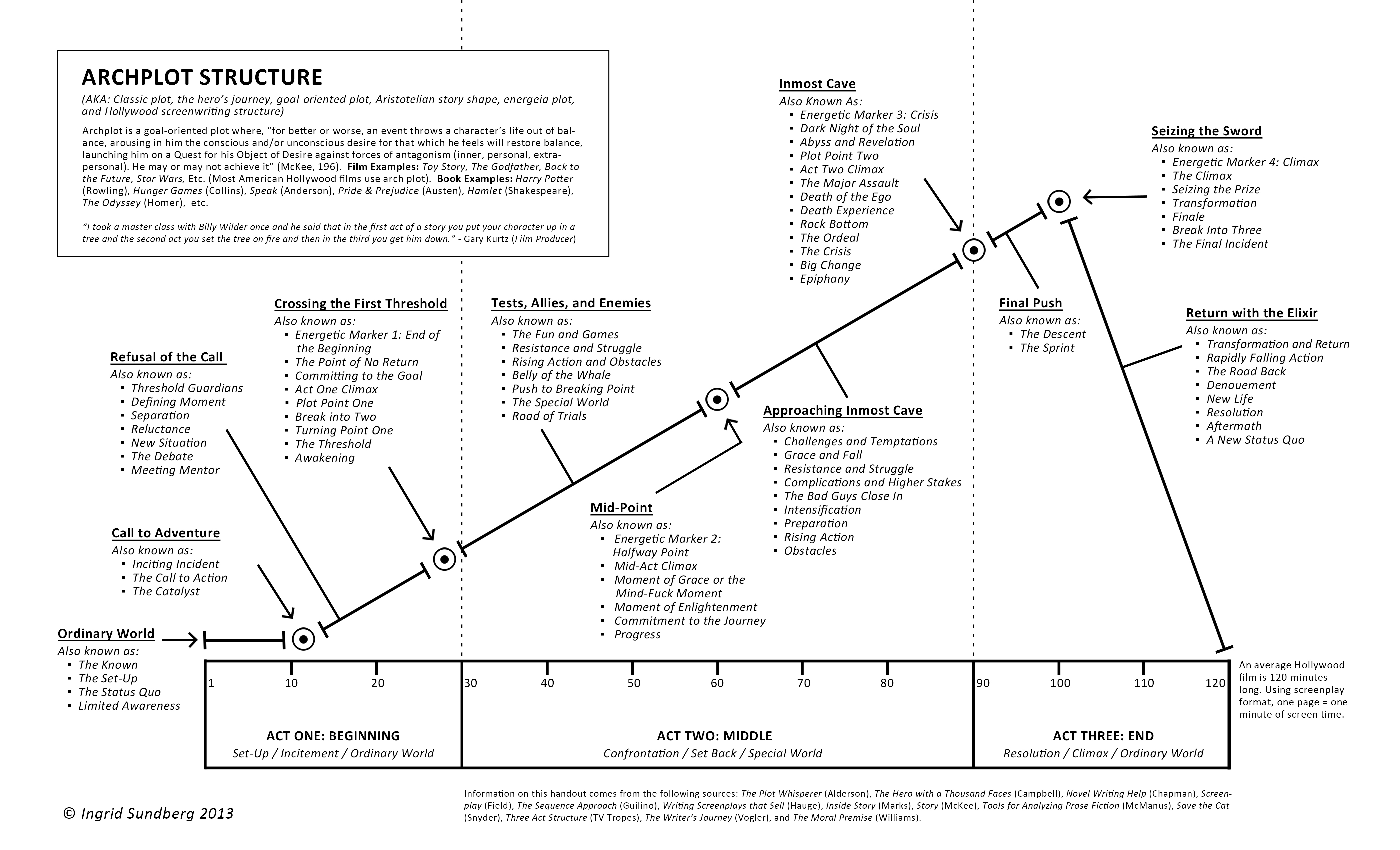
This diagram provides a visual description of the Three-Act Structure featuring the various points that the Hero’s Journey travels in a typical western screenplay. I particularly love this diagram because a lot of resources explain the same elements of the Three-Act Structure using different terms and this diagram blends them all together in one helpful visual.

Although controversial, I also included Blake Snyder’s Beat Sheet which offers a page by page breakdown of where elements of many successful screenplays typically appear. This structure doesn’t apply to all great scripts, and critics complain that it makes storytelling too cookie-cutter, but I think this is an extremely helpful tool for writers who have written a script but can’t quite pinpoint why a certain scene isn’t landing with readers or why a certain character isn’t having the impact they want. I also found this calculator that translates the number of pages of your script into the beats so you can use this as a diagnostic tool. Again, these aren’t “rules” that scripts must follow, but they can help diagnose problems that might be hard for a writer who is very close to a script to recognize.

Writing for Horror

The workshop offered a special emphasis on writing for horror, because the CMU Film Club is creating short films with a Halloween theme. I am not a big horror writer–in fact, I’m kind of a chicken when it comes to watching scary movies–but I dug up some helpful information.

Tips for Writing Horror:

  • If the film isn’t scaring you as the writer, then it may not be powerful enough to work on audiences.
  • Horror films and jokes have a lot in common: they have a set-up, they answer a question, and they deliver a punch-line or a twist at the end. Make sure that punch-line lands.
  • Show don’t tell: horror is a visual art.
  • Horror is not always concerned with why or how a monster or metaphysical entity does something, but it’s very concerned with what is happening.

Henrik Holmberg offered some helpful tips for writing horror and I found this blog by Chuck Wendig to be very useful.

Sample Short Horror Films:

The best way to learn to write horror is to watch other films and read scripts. Compare how The Offering delivers on world-building, suspense, character-building and relationships to how La Boca Del Leon tells its story. Were both films equally surprising? Which elements helped or hindered these stories?
 

“How to Get Your Work Produced” Panel Oct. 18

On Saturday, October 18, I’ll be moderating a panel discussion called “How to Get Your Work Produced” in Berkeley, CA for Play Cafe. The panel will be a fantastic opportunity to check in with other writers about what it takes to get work produced for theatre as well as to hear advice from five knowledgable and experienced panelists: Melissa Hillman (Impact), Eric Reid (Theater MadCap), Jennifer Roberts, Carol Lashof, and Anthony Clarvoe.


Saturday, October 18, 2014

2pm-5pm

Berkeley School of Theatre, Bakery, 2071 Addison Street, Berkeley, CA


Play Cafe presents a panel discussion to help playwrights gain insights into how to get their plays produced.

Featuring Advice and Experience from artistic directors Melissa Hillman (Impact) and Eric Reid (Theater MadCap) as well as experienced playwrights Anthony Clarvoe, Carol Lashof, and Jennifer Roberts.

Moderated by Tracy Held Potter

Our panel represents decades of experience from Bay Area artistic directors who are committed to working with local and emerging playwrights as well as playwrights who have had their work produced locally and nationally and have experience writing pieces on commission or self-production. (Bios are available at http://www.playcafe.org.)

We will open the discussion with moderated questions to the entire panel, and then we will continue the discussion with an audience-led Q&A. The afternoon will conclude with social time and refreshments.

Our panel will be held at the Berkeley Rep School of Theatre at 2071 Addison Street. We will be in the Bakery Room on the first floor (wheelchair accessible). There is paid parking across the street and our venue is one and a half blocks from Downtown Berkeley BART.

Pre-purchased tickets are $30.00 general admission and $25.00 member (to become a member, visit http://playcafe.org/memberships/). Door sales are $35.00 general admission and $25.00 for members.

For more information, contact Tracy Held Potter, Executive Director, at tracy@playcafe.org.

Purchase Tickets Online

http://www.playcafe.org


Status of Female Directors in Film

Point Park University has revived its film magazine Cinemastilo by converted it to an online project. I recently wrote a blog article focusing on the low representation of female directors in film.


Female Directors in the Film Industry: Fair Treatment?

By Tracy Held Potter

Originally posted September 23, 2014 at Cinemastilo

For any filmmaker, there’s nothing more exciting than watching a group of people coming together to transform his/her script into a set brought to life by thoughtful actors and edited into a cleanly-cut film. However, there is a rising issue of the lack of representation of women in film. Depressing statistics tend to provoke activists with two reactions: “Agh!” and “What can I do about that?”

With all of the accessible film technology available today, it seems like a great time for anyone with the drive to get involved with filmmaking, but if that’s true, why are the statistics of women’s representation in film stagnating or declining? One of the most interesting statistics is the status of female directors, because directors both maintain the overall voice of the film and they have a very significant influence on the team that is assembled to create the film.

According to the 2013 “Celluloid Ceiling Report,” an ongoing study conducted by the Center for the Study of Women in Television and Film at San Diego State University, women represented just 6% of directors working on the top 250 grossing films of 2013 (in contrast, the figure was about 39% of women directing Off-Broadway plays during the same period).

Why should we care whether men or women are directing films? According to World Savvy, gender equity is a human rights issue that, when in balance, can lead to “powerful and meaningful economic and social change.” The idea that women and men have equivalent access to opportunities for employment and for their voices to be heard means that our society benefits from the participation of more perspectives into how we shape our world.

Maybe it feels like a leap to jump from human rights to storytelling, but considering that all of our decisions are influenced by the stories we hear and the ones that created within ourselves, from childhood onward, we realize how important it is to access as much of the human experience as possible—not just those interpreted by men.

Interviews were conducted with several early-career female directors about the representation of women in film directing to get a sense of how their gender has or hasn’t affected their experience in the industry.

Talia Shea Levin (All-Sight), a film director currently studying directing and creative writing at Carnegie Mellon University, says that these statistics are “pretty much all that I think about every day.” She doesn’t accept the low representation of women in film, believing that if she shows up and “does the work” then she should receive the same rewards that male directors get for the same work. Even at this stage of her film career, Levin has experienced disempowering forms of sexism. As a director on set, she has sometimes felt that other members of the team try to “take care of” her in ways that undermine her authority. For instance, when tension was high on a set and she was trying to get a collaborator to take on a task, that individual told her, “Calm down, it’ll all be okay,” instead of taking care of the job that person was asked to do. Levin was convinced that this collaborator wouldn’t have said the same thing to a male director.

After more interviews, it became apparent that overt sexism was less of an issue than the presence of subtle or “institutionalized” bias. …

Read the complete article at Cinemastilo.

31 Plays in 31 Days Challenge Completed

Two minutes before the 31 Plays in 31 Days Challenge ended, I submitted my 31st play.

Rachel Bublitz and I founded this challenge to inspire writers to write 31 plays in the month of August purely to generate more material and to get out of our heads. In the first year, hundreds of writers from around the world participated. This year we hosted our third challenge, marking the second year that I’ve participated as a writer.

Even as a founder who knew the purpose of the challenge was to generate scripts without self-criticism (re-writes come later), I still had to fight against my self-doubts and critiques. I also realized about half an hour before midnight that I wasn’t as far along with my scripts as I thought–whereas I thought I had written 28 scripts, I had really only written 24. Yikes!

As the minutes clicked toward midnight, I started to tell myself to stop writing and just go to bed. But what kind of a role-model would I be if I gave up so soon?

I crammed out as many scripts as I could–modeling them after objects in my immediate vicinity and, thanks to a Facebook comment, my trip to Chuck E. Cheese. Six minutes before midnight, I pushed to complete a typo-ridden yet “complete” script called “Winning” and I submitted all 31 plays before deadline.

Sometimes, success comes in spite of other people’s criticism, disbelief, and negativity. Often, though, we create our own obstacles.

It’s true, I could use a lot more sleep than I get, and I wouldn’t push myself to do a challenge like this all the time, but I wasn’t going to bed within the next half hour, so why not just write?

The image I sometimes call forth at times like these is of the fitness coach standing by shouting for just one more push-up. If you can just go a little further whenever your mind tells you to quit, how much would you be proud of?

Congratulations to all of the writers who participated this year–let’s do this again in 2015!

Merritt Squad! Web Series is Funded!

Merritt Squad!

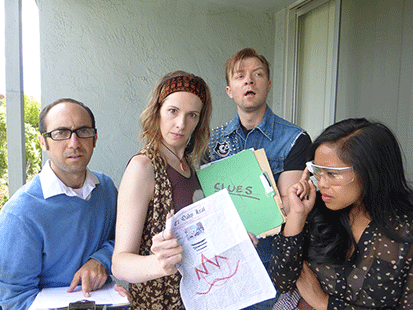
Meet the Merritt Squad! Vince Faso, Maura Halloran, Peter Townley, Carina, Lastimosa Salazar

Colin Johnson and I have been working feverishly to bring our 8-episode web series to life and we’re delighted that nearly 100 backers recently made generous pledges to take Merritt Squad! from our Final Draft software to internet-capable screens everywhere.

Our Kickstarter page features preview trailers with early footage and bios and head shots of our actors. We can’t wait to start posting the polished episodes at the end of 2014!

Science Fair the Musical wins Sloan Screenwriting Prize

On Sunday, August 10th, I was honored that my full-length screenplay “Science Fair the Musical” was one of four first place screenplays in the Alfred P. Sloan Screenwriting Competition at Carnegie Mellon University. I am planning to use part of the $9,000 cash prize to work with a composer to develop music for the songs. Congratulations to my co-winners Josh Ginsburg, Julie Jigour, and Savannah Reich for also putting together incredible work!

Newer posts »

© 2026 Tracy Held

Theme by Anders NorenUp ↑